

Eliminating Specular Reflections in Drone Inspections for Enhanced PV Data Acquisition
Every drone inspector knows the frustration. First, you plan a flight and deploy your crew. Then, by mid-morning, the first images come back ruined: blinding white hotspots blow out entire rows of solar panels where the sun’s reflection overwhelms both the RGB and thermal cameras.
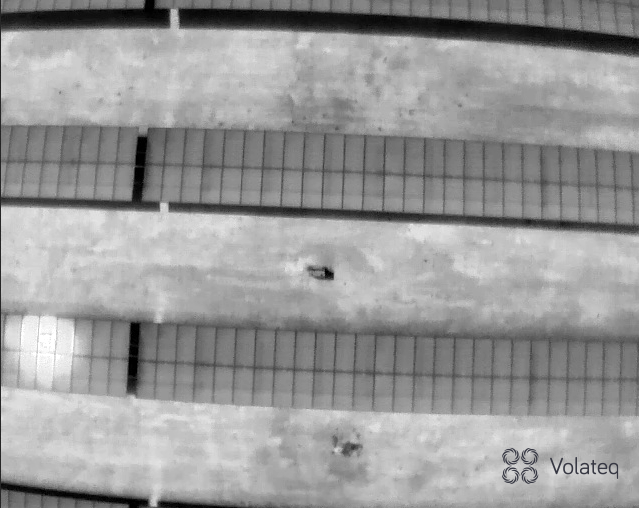
Specular reflections (sharp, mirror-like sun reflexes off the glass surface of PV modules) are not just a visual nuisance.
In thermographic inspection they mask the very anomalies you are trying to find. For example, a reflection that registers as pure saturation can hide hotspots, bypass diode failures, and underperforming strings.
Moreover, in IR-based defect detection, the same reflections generate false positives and corrupt module segmentation.
So, what is the practical consequence? Many operators simply accept a significant share of unusable frames, others spend time manually reviewing and discarding affected imagery. Either way, both approaches drive up cost per megawatt and limit throughput.
Our approach removes this constraint entirely.
Our standard processing pipeline automatically detects and removes sun reflexes from both RGB and thermal imagery, before any analysis takes place.
Computer vision models drive the detection. Specifically, we trained them on large, purpose-built datasets of drone imagery from real-world PV inspections. These datasets cover a wide range of sun angles, module types, and environmental conditions.
As a result, the models have learned to reliably distinguish specular reflections from the defects and surface features that matter. They stay accurate even in challenging edge cases where the two can look deceptively similar. Additionally, we handle both cameras independently, because a sun reflex can appear quite differently across the visual and thermal spectrum.
In real-world deployments, we consistently remove up to 99% of sun reflex occurrences.
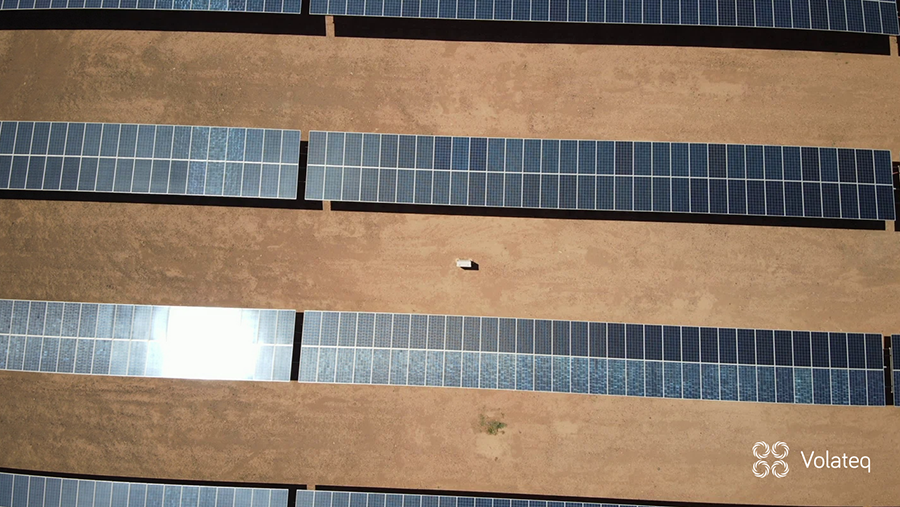
The entire process runs automatically as part of our data processing pipeline: first, it identifies affected regions at the frame level; then, it excludes them from all downstream analysis.
Consequently, orthomosaic generation, anomaly detection, and thermographic reporting all operate on clean input.
This means sun reflections no longer hold back your operations.
By eliminating them systematically, we increase the usable data acquisition window. At the same time, we significantly reduce the share of input data lost to reflection contamination.
As a result, more of every flight contributes to the final result. Campaigns become easier to plan, and inspection reports reflect the true state of the plant, not just the frames that happened to be reflection-free.
Sun reflexes have long been accepted as an operational constraint in drone-based PV inspection. We treat them as a problem with a solution; and that distinction matters at scale.